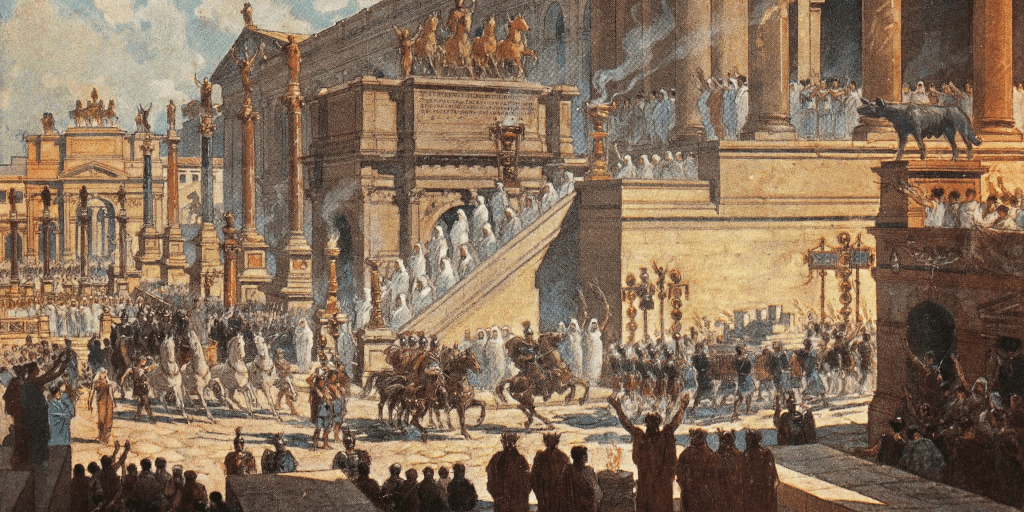
• The second origin of the praetorian guard’s serious threat to the Empire would be their immense power that came from the occupation itself. Captains of the praetorian guards (Praefectus Praetorio) were the few officials who served directly under the emperors themselves alongside a few other ones such as the Egyptian provincial governor*. The reason for this was evident which was that this particular position, dedicated for managing the emperor’s safety, should be manipulated by the big man himself. Nevertheless, there were times when the Roman emperors failed to excess restraints over them. Also, the Roman praetorian guards, unreasonably I feel, were the only armies that stationed themselves within Italy, allowing them to became the sole dominating military force in the region of the Roman capital. And, “best” of all, the other legions in the whole territory of the Roman Empire. Other legions were either too far away or too weak to defeat the praetorian guards (or most likely both), so that they were unable to triumph over the praetorian guards as quickly as possible once they took control. This part of the guards’ privileges also accounted for why the Senate was unable to rival their power, because when grievances were created between the Senate and the praetorian guards, senators were not able to use military interventions, limiting their methods for countering the legions to only doing paper works which greatly reduced the Senate’s influence over the praetorian guards. These two factors contributed to many great problems in Rome, especially corruption, for who wouldn’t use the extreme power they had to acquire tons of gold and more authority. The praetorian guards in Tiberius’s time is a fine example of corruption. Tiberius had an ambitious commander for the praetorian guards who was called Sejanus. This person bribed many of the soldiers within the praetorian guard, granting him even more power than before. Sejanus also took advantage of Tiberius’s trust and used his trustful legions to deter the Senate to make sure that they were unable to sabotage his dominion. As a result, immense power was attained by him and he became the second if not the first most revered person in Rome at that time. Though Tiberius noticed this after a while and killed him and his more loyal supporters, he set the opening for several hundred years of corruption of the praetorian guards that originated from their positions.

    Overall, the praetorian guards had generated great troubles in Rome and is one significant factor contributing to its downfall because of their hard-to-maintain loyalty and their high authority.

    *: Interestingly, the reason for this is because of the Egyptian’s belief that Egypt should only by ruled by someone related to God, which made Egypt become the private of the emperor. Hence, the emperor would assign a governor that is only, in theory, assisting the emperor’s direct domination over the area

  • Being a Chinese, I am not too unfamiliar with the imperial guards. We Chinese have abundant opportunities to see TV shows that depicts Chinese imperial guards as extremely loyal to the emperors of China. In contrast, the Roman imperial guards or rather the praetorian guards (praetorium) are far more troublesome and, though they did not strike one of the final blows, contributed significantly to the Roman Empire’s decline.

    Of course, the praetorian guards is definitely one of the most visible symbols of imperial dominance in ancient Rome. The first of these troops appeared in the Triumvirate era, where all three most powerful political figures at that time (Caesar, Crassus, Pompey) all had their own armies that protect their safety and fight for their cause. Nevertheless, those armies weren’t official praetorian guards and the first true ones did not appear until the Augustinian time. Even then, the guards didn’t actually control the city Rome as much as later guards did, for they were still placed outside Roman capital, serving as a defensive line for any instabilities inside the city or outside it, but only merely such. Things changed, however, during Tiberius’s times. He made the quite interesting decision to relocate the guards to within the capital. Only at this point, I believe, is when the guards finally obtained the true path to power and henceforth became a great cause of distress for all later emperors. Why may those troubles be caused then? There are two major reasons that I would like to point out which the problems with money policies the emperors enact on the praetorian guards and the corruption that generated from the status of being a praetorian guard. The second of which will be introduced in the next entry.

    First, the policies, especially the payment, that emperors impose on the praetorian guards may damage themselves. it is prudent to note that during the beginning phase of this particular type of Legion, the soldiers within this troop were elites of the entire Roman army. They were selected from multiple legions within Roman territory through their own records, with extremely high standards. Thus, reasonably of course, they were granted a significant quantity of salaries every year that is at least two or three times the salaries of a common Roman soldier, alongside handfuls of rewards from the masters they serve, all of these were decided by the emperor. These factors raised massive problems, though. Regarding the fact that the leaders of those troops does not have any actual relationships with the emperors caused the “Princeps”(Name for Roman emperor in Latin, means “first citizen”) to try to pay gigantic amounts of money to them in order to maintain their loyalty. This action was less like filling a hole that can be measures with a long enough ruler, it is more like chucking gold and silver into a Black Hole that gets bigger and bigger with each kilogram it consumes. The greed of the praetorian guards can never be fulfilled and their appetite for riches would get more overwhelming with each change of emperors. And if an emperor hesitated in feeding this beast, it will tear him apart and search for new emperor that are willing to pay them handsomely. The full absurdity of this could best be observed during the civil war of 68-69 A.D., where Galba, who refused to pay that large amount of money that the guards require, were killed by the praetorian guards, and Otto, who yielded to the Legions demands, didn’t die in the hands of this army. An even more ludicrous example occurred during the civil war in 193 A.D., where Julianus and Sulpicianus competed the throne by each trying to offer higher prices to the praetorian’s guards. Both incidences resulted in immense political unrest especially in the boarder legions who considered themselves as just as capable as praetorian guards and who saw this rapid change of leader caused by payment to the guards as both a discrimination and an opportunity for securing power themselves, making this practice of the guards as very disastrous for the Roman Empire’s stability.

  • The destruction of ancient Rome, just as its ascension to power, did not happen overnight. Indeed, it is the combined product of centuries of decline evident in multiple fields, most significant of which were border protection and the overall economic trend. It is also prudent to note that not all emperors after Aurelius were terrible rulers who had wasted their lives on watching magnificent fights of gladiators and drinking wine in their office (the latter is just something that could potentially happen and would be deemed indecent by the Roman communities). On the contrary, a large portion of emperors actively tried to make the country better, including the notorious Caracara. But, as a cliché rightfully pointed out, “The road of hell is paved with good intentions.”

    Those policies, created for good causes, were the ones that struck Rome blow after blow, accumulating more and more prominent risks and conflicts. And in those were a few good policies, which, if persisted and improved through generations (which obviously they hadn’t) could help the empire to survive a little bit longer and perish a little less tragically.

    And these are what my little, tiny blog will be about. I want to introduce those vital policies that either stimulated Roman’s downfall or appeared as one that could potentially turn the tide, and share my piece of insight. Though keep in mind that these entries that I have written may not be entirely comprehensive.

    So, welcome to Cataclysm Rome.

  • Welcome to WordPress! This is your first post. Edit or delete it to take the first step in your blogging journey.